

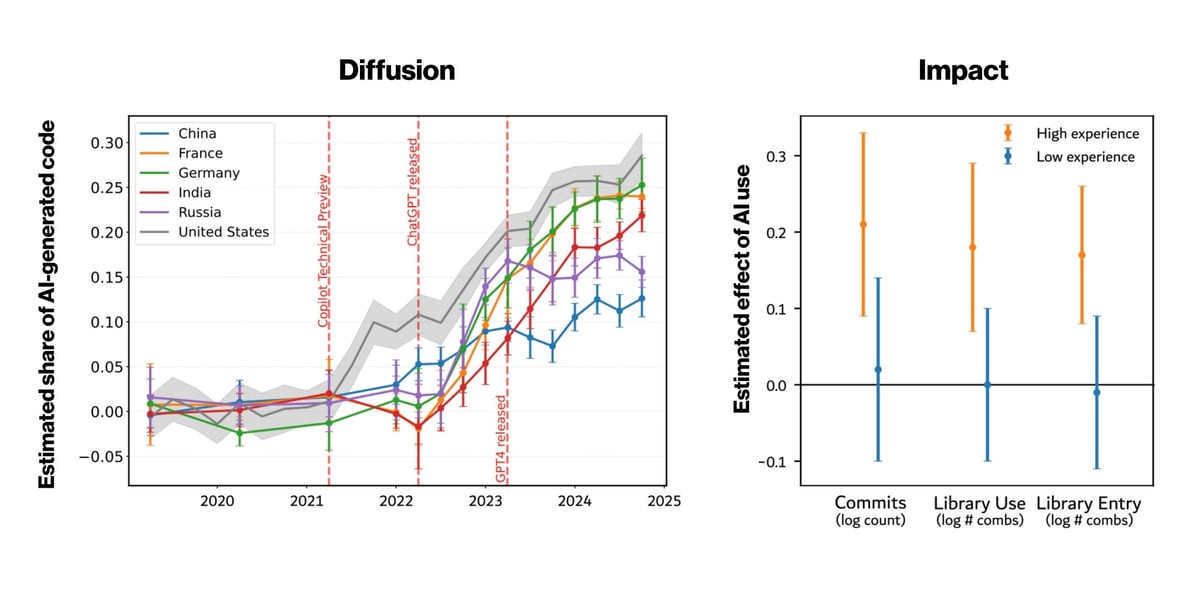
A paper in Science, led by Simone Daniotti at the Complexity Science Hub, measured AI in the wild rather than in a lab. The team analyzed more than 30 million Python contributions from about 160,000 GitHub developers between 2019 and 2024. By early 2025, AI had a hand in roughly 29% of new software functions written in the United States, up from 5% in 2022. France was at 24%, Germany 23%, India 20%.
The productivity number is modest: 3.6% by the end of 2024. The distribution of that number is the finding. Less experienced developers used AI for more of their code, 37% against 27% for experienced ones, but the productivity gain came, in the authors' words, exclusively from experienced users. Beginners used the tool more and got less from it.
I think that result matches what I see and has a plain explanation. An experienced developer knows what the code should look like, so a generated draft is a starting point they can correct in seconds. A beginner cannot tell a good draft from a plausible one, so the tool replaces the part of the job they had and leaves the part they did not have yet.
The staffing implication I draw is uncomfortable but I think it is right: the tools raise the value of experience, which means a team cannot grow its own experienced developers by handing juniors a tool. It still has to teach them, and I think it has to teach them judgment first.
On your team, who gets the most out of the coding tools, and is that who you expected?
Photo source: https://photos.robertstowe.com/bengaluru